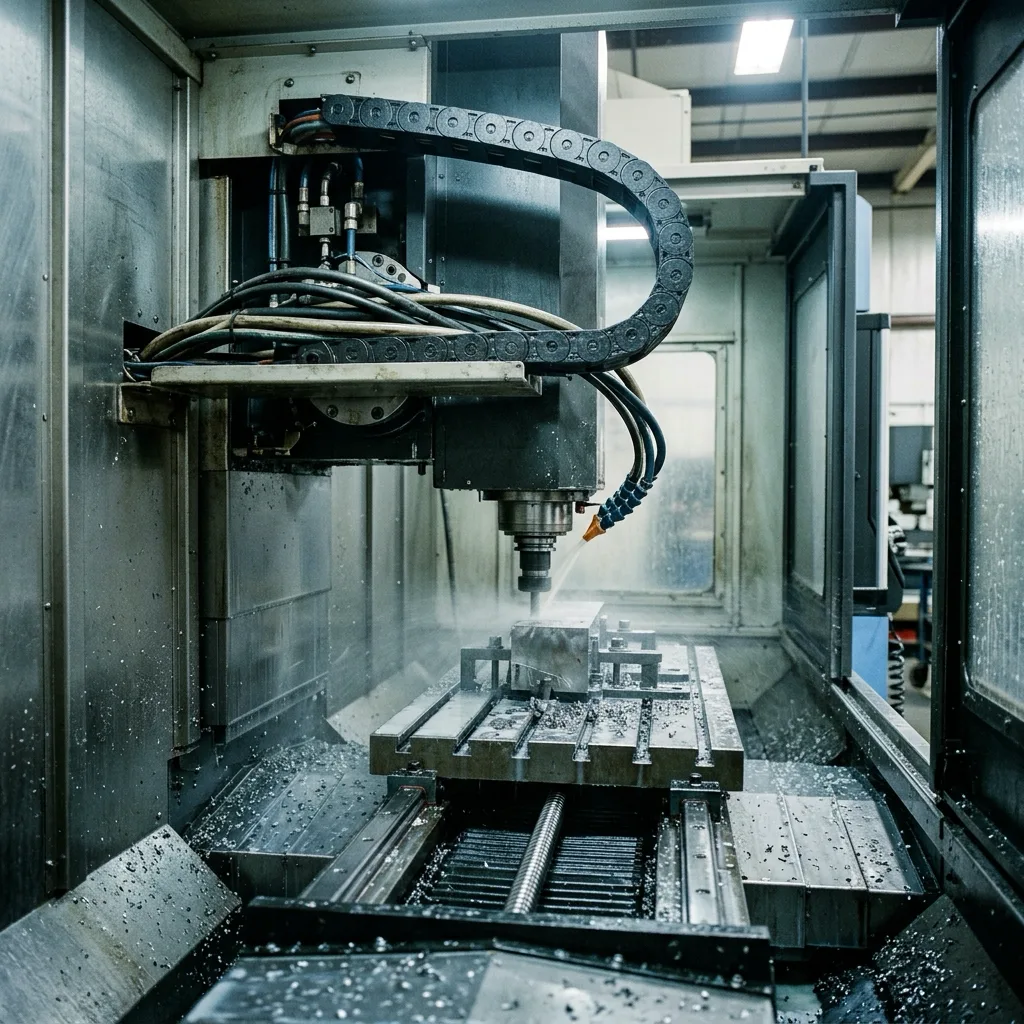
Continuous flex · PUR
CNC machine tools & machining centres
Table and spindle axes reciprocating through coolant, calling for a continuous-flex PUR build at a tight bend radius.
Continuous-flex drag chain cables for cable carriers and energy chains — fine-stranded Class 6 copper over a central tensile element, short lay-length braided cores that resist migration, protected by an oil- and coolant-resistant PUR sheath — in continuous-flex, torsion and robotic builds, at a tight bend radius of about 7.5–10× the cable OD, engineered to survive millions of controlled reciprocating flex cycles inside the carrier without core breakage or corkscrewing.
The hardest thing a drag chain cable does is not carry current — it is to keep its cores still on the inside while a machine bends the outside back and forth. Left alone, cores creep toward the outside of every loop, corkscrew, and eventually push through the jacket. This cable is built specifically to stop that, so this section is about the structure that keeps the cores located — the tensile centre, the short lay-length braid and the fine Class 6 copper they carry — with the full flex ratings in the table below.
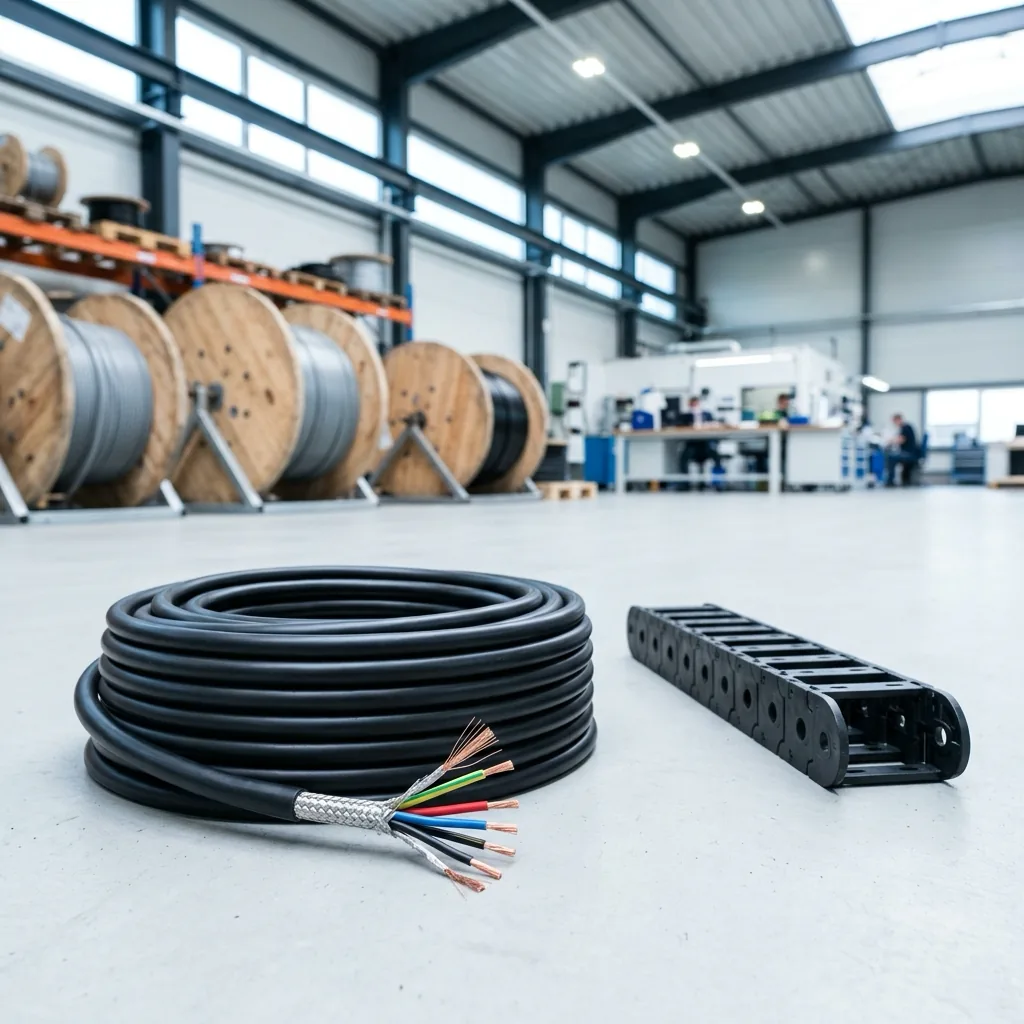 Continuous-flex cable-carrier / energy-chain cable
Flex-core bundle — cores held on a tensile centre and short-lay braid so they stay located through every loop
At the heart of the bundle sits a tensile / support element that absorbs the pull of every stroke, so the conductors are not stretched and dragged out of position as the cable reciprocates. It is the part no fixed or general mobile cable carries, and the reason the bundle keeps its geometry cycle after cycle.
The cores are laid up at a short pitch and braided so that through each bend they bunch and spring back as one instead of migrating to the outside of the loop or knotting. This is the mechanism against corkscrewing — precisely what a controlled, machine-driven reciprocating duty demands and a free-hanging lead never does.
Each conductor is a Class 6 bundle, finer and more numerous than the Class 5 used in general flexible cable, so it tolerates the high cycle count of carrier duty; here it supports the anti-migration build rather than standing in for it.
Over the located bundle sits a polyurethane jacket, chosen to shrug off machine oil, coolant and abrasion while staying supple at a tight radius — PUR the carrier default, PVC or TPE where cost or a milder duty allows. Its ratings are set out in the table and the flex-life section, not re-argued here.
Match the way the machine moves the cable — straight-line reciprocation, rotary torsion or a robot's combined path — and the carrier's minimum bend radius, to the right build. Every figure here is a general continuous-flex or cable-carrier standard, given as a multiple of the cable's own diameter rather than a fixed millimetre, and this table is the one place the full ratings are set out.
All builds use fine-stranded Class 6 copper over a central tensile element with short lay-length braided bundling for anti-migration, under an oil- and coolant-resistant PUR (or PVC/TPE) sheath — rated for continuous flexing (millions of flex cycles as a duty class, stated from the cable-carrier flex standards, not a quoted cycle count) and built to EN 50525 / UL AWM.
Tell us the flex type (reciprocating, torsion or 3D), the carrier's minimum bend radius, the core mix (power / control / data / servo), the core count and cross-section, the travel and speed, and your sheath preference — our engineers confirm the exact build, with third-party test reports available.
A drag chain cable is not tested by one hard bend — it is tested by the same small bend repeated until something gives. Two things can give, in different ways: the copper can fatigue and break at the flex point, or the cores can drift to the outside of the loop, corkscrew and burst the jacket from within. A carrier cable has to hold off both at once, at a radius far tighter than any cable is bent by hand — and it does that through two parts of its build working together.
The Class 6 conductors and the short-lay braid share each stroke's bending across the whole bundle, keeping the copper worked well inside its fatigue limit; the cable is rated for continuous flexing — millions of cycles as a duty class — and we state that from the cable-carrier flex standards, never as an invented cycle number.
Because the cores sit on a tensile centre, the cable returns to the same ≈7.5–10× OD loop stroke after stroke without the radius creeping open or the bundle stiffening, so it keeps both fitting and surviving inside a small carrier.
This is what a carrier cable has that a mobile cable does not. The short lay-length braid and the central tensile element together stop the cores drifting to the outside of the bend, knotting or corkscrewing, so they never work their way out through the jacket. It is a failure a free-hanging flexible lead never has to resist, because nothing forces it through a controlled loop over and over.
On a robot's rotary axis the same short-lay braid lets the bundle twist and recover without the cores unlaying, so a robotic build survives the combined reciprocation-and-twist path rather than only a flat back-and-forth.
PUR against oil & coolant. The polyurethane jacket resists machine oil, cutting coolant and abrasion and stays flexible cold, so the media around a machine tool or robot do not swell or crack it over the flex life — a different job from outdoor UV ageing, mine-water corrosion or charge-cycle heat. What the endurance rests on is mechanism, and the flexing standards written for carrier cable — EN 50525, UL AWM and continuous cable-carrier flex testing — never a fabricated cycle count, bend-radius millimetre, production case or customer name. That is the claim we stand behind.
Every moving axis puts a different kind of flex on the cable in its carrier, so each of these maps to the flex type, bend radius and sheath it runs on, not a single stock cable.
Table and spindle axes reciprocating through coolant, calling for a continuous-flex PUR build at a tight bend radius.
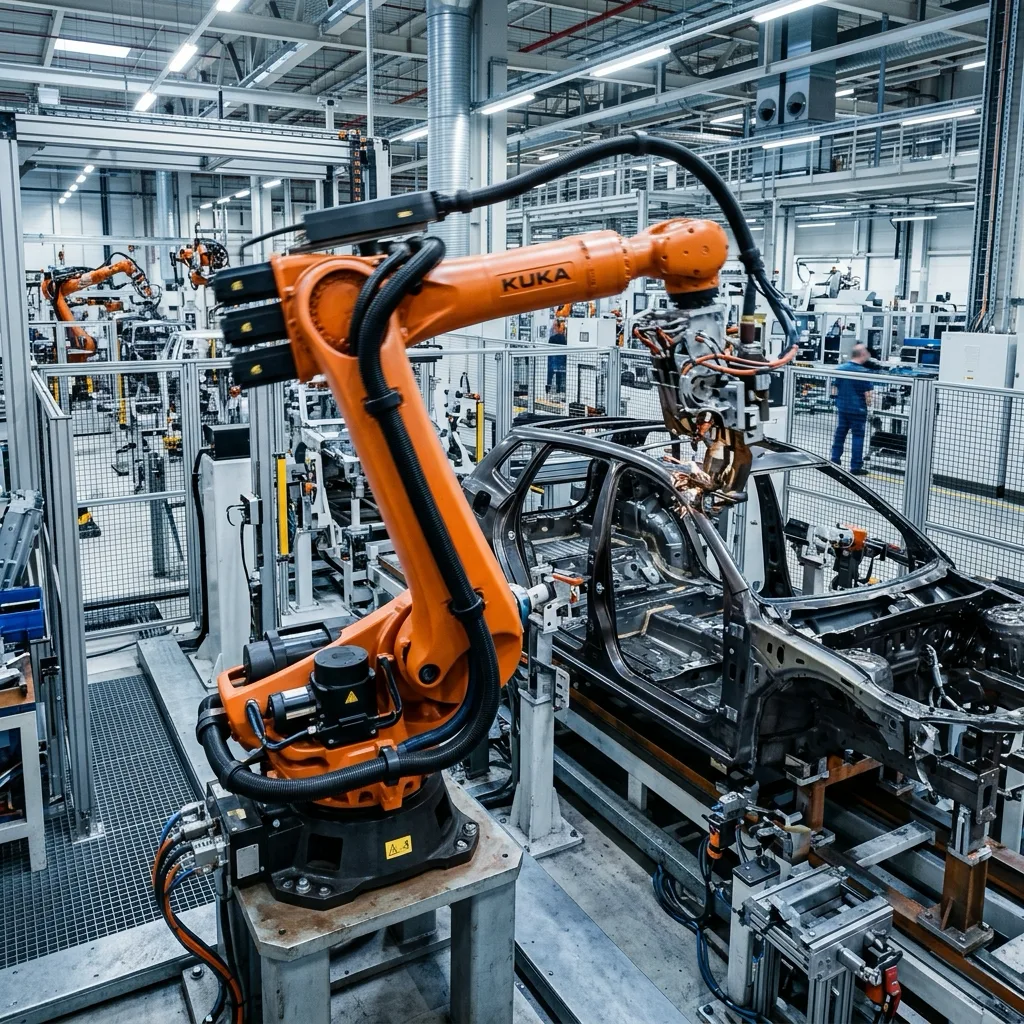
Rotary and compound motion with real torsion, matched to a torsion / robotic short-lay build.
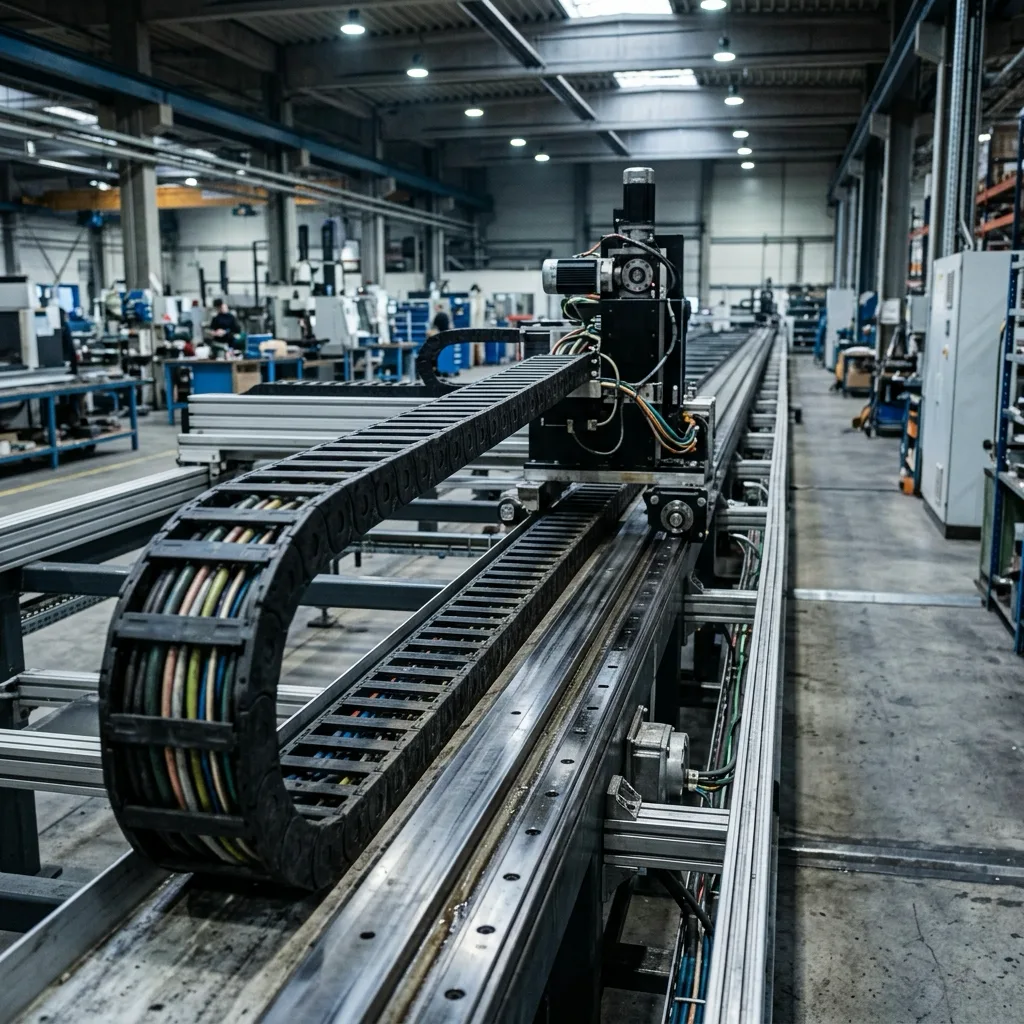
Long, fast reciprocating travel where the tensile centre keeps the cores from being dragged out over the stroke.
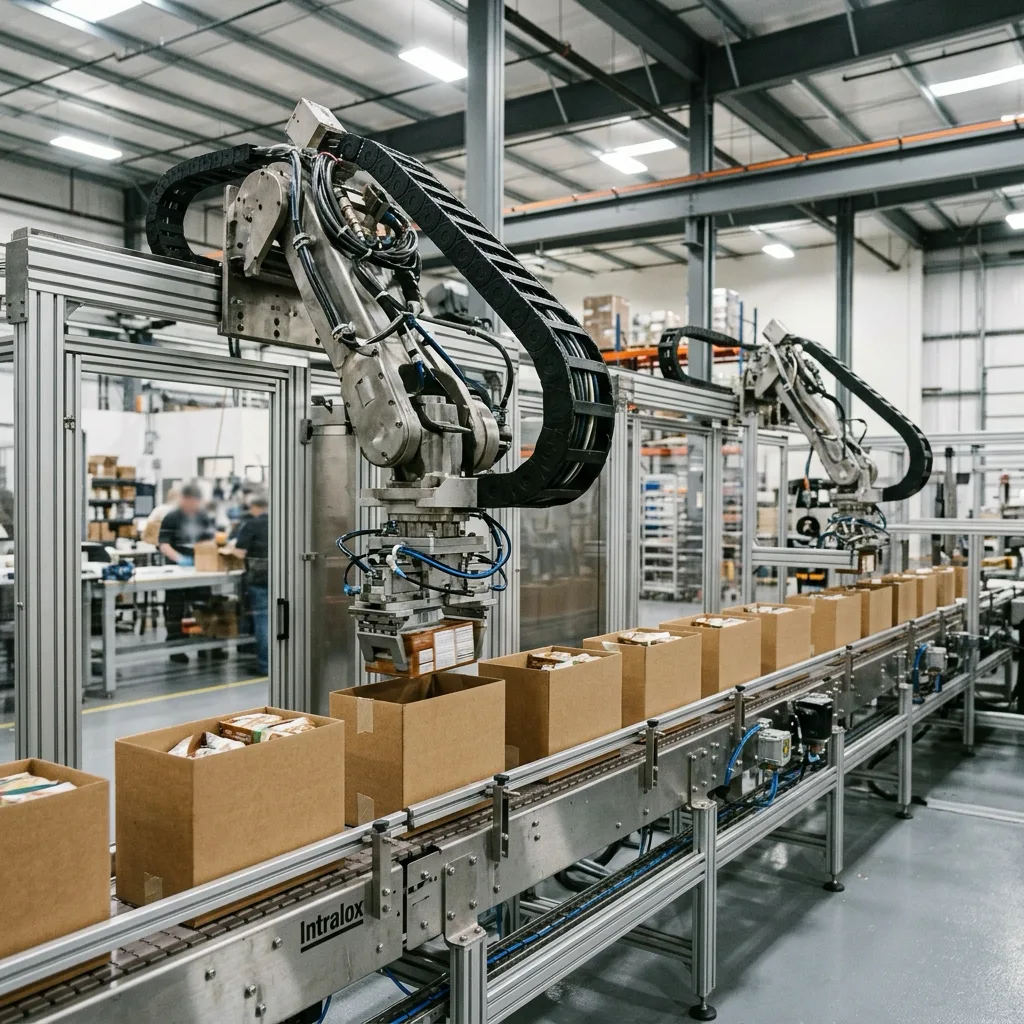
Multi-axis, high-cycle motion where an abrasion-resistant PUR or TPE carrier cable holds up shift after shift.
A drag chain cable never fails where you can inspect it. It passes every bench check, goes into the carrier, and gives out a million cycles later — and when it does, it is not one lead that stops but the whole machine or line waiting on that axis. Since flex life and anti-migration are exactly what an incoming check cannot see, what matters is how the cable was built and whether that build stays identical reel to reel. That is where it counts that the same factory draws the copper, lays up the bundle and extrudes the jacket for every reel — across 30 years as a long-term State Grid supplier — holding the things that decide carrier life, the tensile centre, the braid lay and the PUR wall, consistent from the first metre to the last, testing every reel at 100% in an in-house German-standard laboratory before it ships and putting the full certification set (CE, UL, TÜV, SAA, RoHS, IEC and ISO 9001) on file, with third-party reports for your flex spec.
See the full factory, quality system and certification record on our About pageA drag chain cable is specified from the outside in. The carrier's inner space and its minimum bend radius cap the diameter and settle the flex type before a single core is chosen — so we start from the chain and the motion, then build the cores to live in the room that leaves.
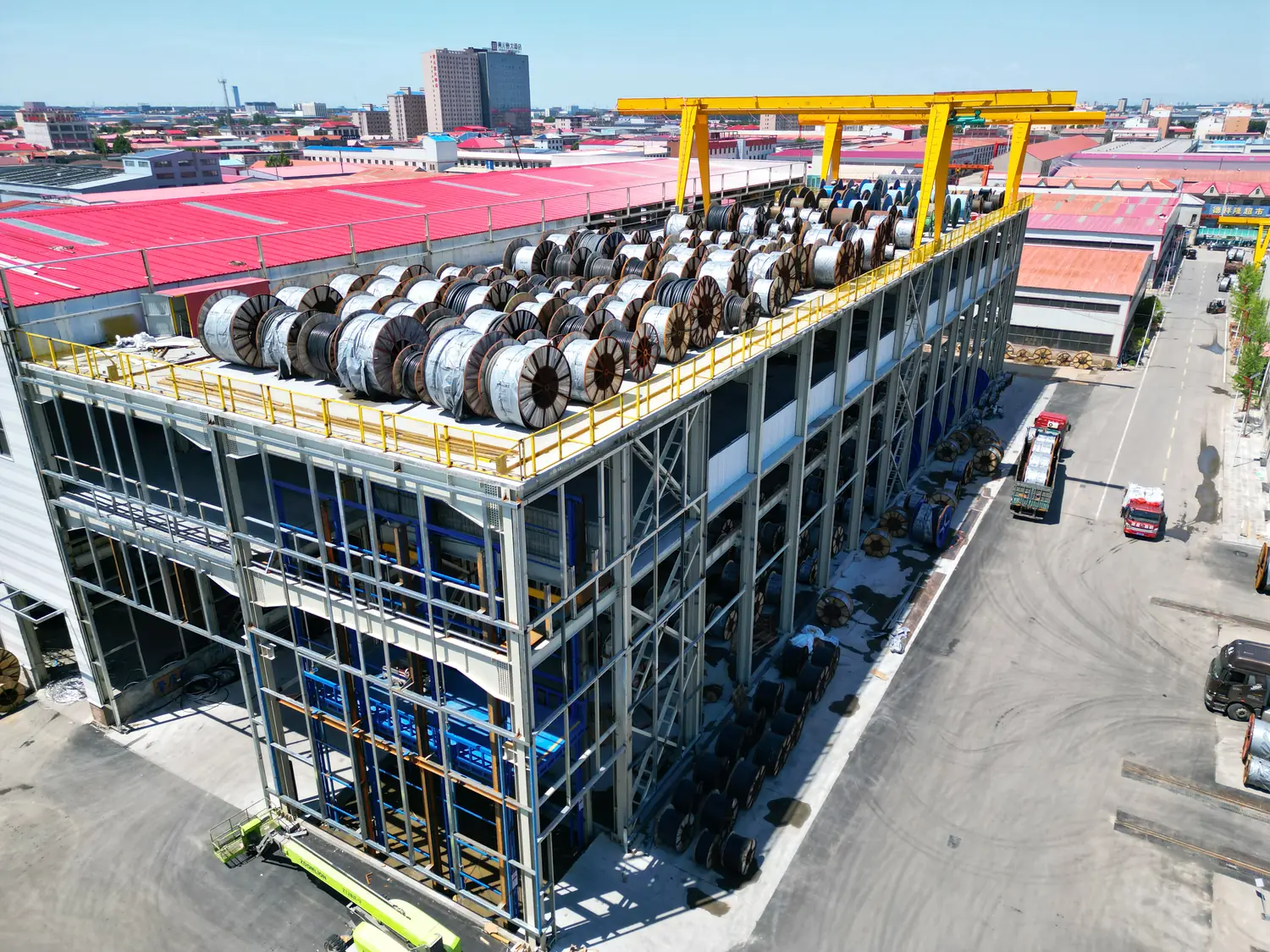 Own production lines — carrier runs built to spec
A single machine rarely needs one drag chain cable — it needs a dozen different ones: a power build for the spindle axis, a servo build for each robot joint, a data build for the sensors, each a short run and none of them in bulk. The 500-metre minimum is sized for exactly that — a whole machine's worth of one flex spec, not a bulk load of a single cable — and each of those short runs is built to the machine's shipping date, so the full set arrives together rather than trickling in behind larger jobs.
Flex type, bend radius, core mix and cross-section.
Scheduled and tracked through to dispatch.
Every reel tested 100% before it leaves.
A machine's full set of flex specs lands together, customs handled.
Send your flex type (reciprocating, torsion or 3D), the carrier's minimum bend radius, the core mix and cross-section, and the travel and speed of the axis. Our engineers reply within 4 hours and return a full quote with datasheets within 24.
Prefer to talk first? Email allen@newsun-cable.com or WhatsApp +86 188 7140 0481.